|
PM |  | |
Quote | | |
Reply | | |
Full Topic | |

| Joined: | Thu Mar 26th, 2009 |
| Location: | Colorado USA |
| Posts: | 10254 |
| Status: |
Offline
|

stew77 wrote:
Hammerfjord wrote:Yes, Chris... I saw it in this link:http://www.x-plane.org/home/furo/watches/watches_in_space.html
But the way I see it, the winding would not be optimum as on earth as it comes only from direct impluse...
But it's thrue: A watch rotor can be winded in space.
The question is: Wouldn't a manual winding movement be better and safer for a cosmonaut who's not running around all day? Or an automatic with manual winding feature...?
Oscar: I know that the Lemania is wanted movement but the nylon parts don't attract me... Tissot burned themselfs on that technology...
Yes...that's the link William...good summary and a great way to think about it IMO!
But, I agree with you...if you have to rely on Inertia (direct impulse from the wearer)...it would seem that a manual winding movement would be better and safer without the concern that the watch is getting enough automatic winding through inertial movments of a rotor.
Yes...Well, as I see it, I may have concluded too fast and went too hard on Fortis. But the 5100 Lemania was choosen for it's simplicity as it had a direct transmission, making it more resistant to shocks.
Now Fortis uses ETA movements in it's watches: The same 2826 2824 and 7750 as used in many trades.
All in all, every watch with those movements and a good construction could eventualy be a space watch: After Fortis criteria...
I would still wear an Omega speedmaster "Moon" if I would go in space...
Those ETA movements would never pass any hard space flight test as the Speedmaster passed... And that's certainly why the special property of the Lemania had it choosen for space missions. Even that, they still had the choice of the 52'' serial of Lemania movements who are mechanical...
So why an auto in the 70's and not a mechanical as in the 60's?
Not because they didn't have any auto in the 60's when they first started those missions: There's a bunch of space watches who are mechanicals and who been used in the 80's and 90's so the auto isn't the very first choice apparently, due to them weakness in extreme conditions...
I personnaly had to give up with autos on my job: They break. But my 2801-2 hold everything and never been alterated by any heavy and long hammering.
All good points William...100% agree... I think they went with the manual winding mechanicals for the "OTHER" criteria that had been laid out for space worthiness and extreme conditions.
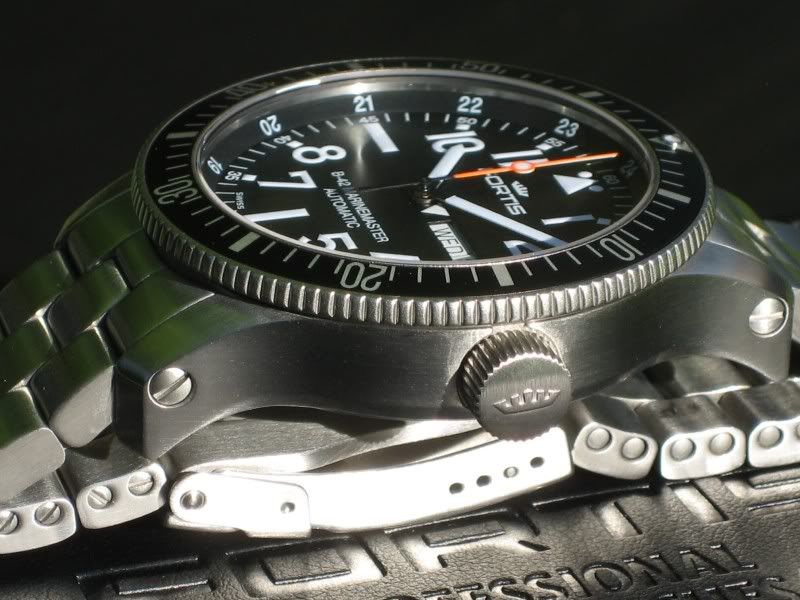
BTW...here is the caseback (and side view) to my Fortis B-42 Marinemaster...I would not hesitate one second to take it on my next trip to the moon!!!
 happy1.gif
It is a fantastically built watch IMO...great value too!